
rQ JOURNAL
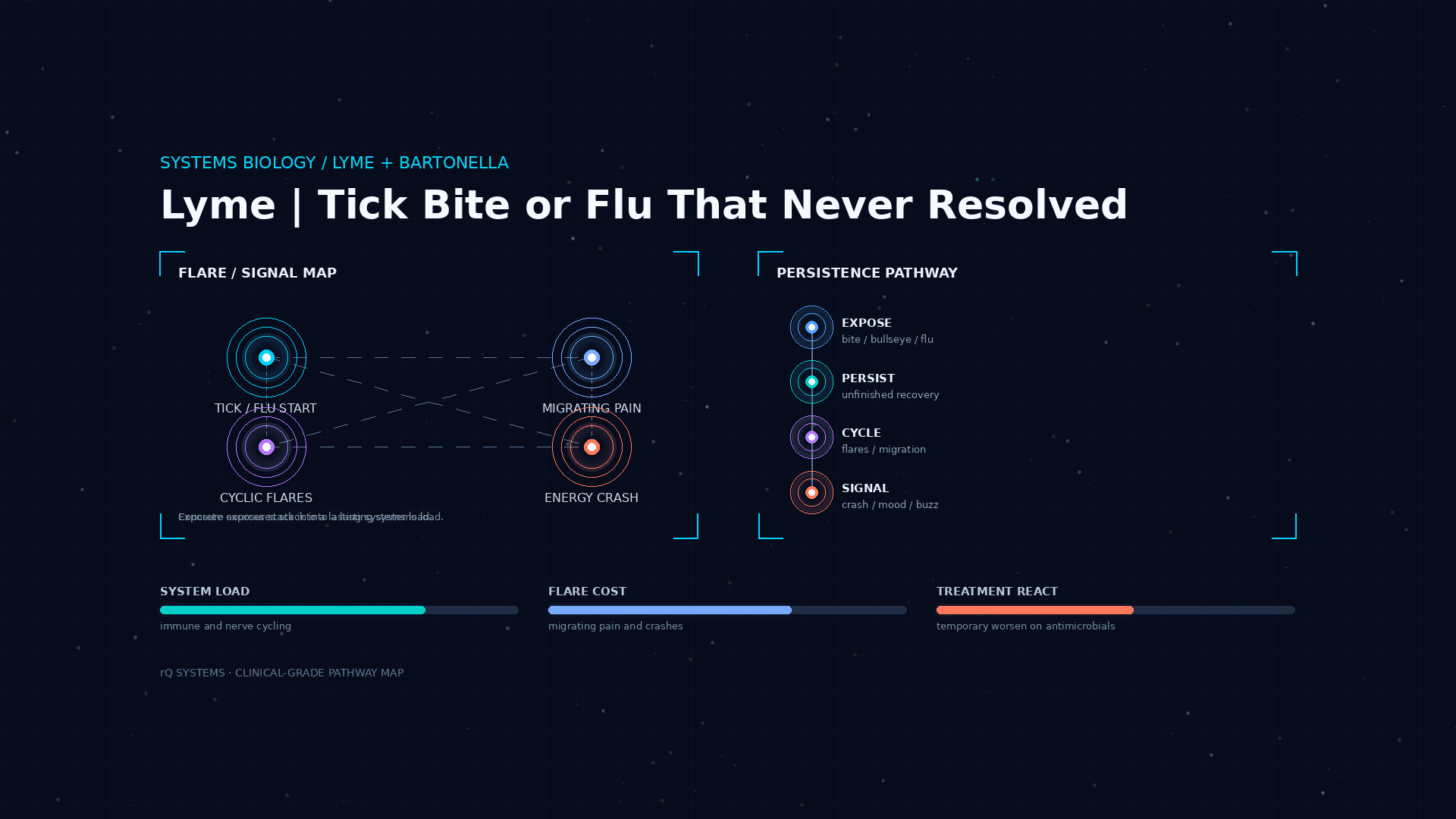
Have you had a tick bite, bullseye rash, or flu-like illness followed by persistent symptoms that never fully resolved?
If that question hits, you already know the unfinished chapter. Something looked like a bite, a bullseye, or a sudden flu. Then weeks or months later the "flu" never fully left. Pain started migrating. Energy crashed without warning. Anxiety or irritability spiked out of proportion. Light, sound, or motion felt sharper than before. That pattern is a signal about how Lyme, Bartonella, and related tick-borne loads can keep the immune system, nerves, and energy pathways stuck in flares.
Lyme and Bartonella are drivers of illness that often refuse a single neat diagnosis. Migrating joint, muscle, or nerve pain, cyclic flares, unpredictable fatigue, sudden mood swings, internal buzzing, and temporary worsening when antimicrobials start are common companions on the same map. People who never saw a tick, or who were told their tests were "borderline," still describe the same unfinished flu-to-chronic curve.
Why a tick bite or unfinished flu can change how you feel
A tick bite or bullseye rash is a clear exposure marker. A flu-like illness that never fully resolves is another door into the same story. Once inside, Lyme, Bartonella, and co-infections can keep immune signaling, nerves, and cellular energy in a cycling load. Pain moves. Symptoms flare without a clean trigger. Fatigue crashes out of proportion to what you did. Mood, light sensitivity, sound sensitivity, or internal vibration can arrive suddenly and feel disproportionate.
That is why "tick bite, bullseye rash, or flu-like illness followed by persistent symptoms that never fully resolved" is such a precise prompt. It maps a defined starting event to a defined unfinished recovery. Related signals often travel with it: migrating pain, sudden anxiety or irritability, sensory sensitivity or buzzing, unpredictable crashes, cyclic flares, and a temporary worsen when antimicrobial treatment begins (a Herxheimer-type response, when die-off chemistry briefly intensifies symptoms).
What Lyme and Bartonella load means in plain language
Think of these infections as persistent operators inside immune and nerve networks rather than a one-week bug. Lyme (Borrelia and related organisms) and Bartonella can lodge in tissues, cycle activity, and keep inflammatory and neurological signals high. The body spends energy containing them. When containment is incomplete, you feel migrating pain, flares, crashes, mood swings, and a system that never quite resets.
Tick-borne load sits beside immune tolerance, co-infections, mold or toxin burden, sleep quality, stress chemistry, and how aggressively or gently treatment is paced. A systems map beats a single "anxiety" or "fibromyalgia" label. An unfinished flu after a tick exposure or bullseye is a high-leverage window because it ties the timeline of symptoms to a concrete infectious driver.
Reading the tick-borne signal with precision
A clear yes to a tick bite, bullseye, or flu-like illness with persistent unfinished symptoms flags a possible Lyme or Bartonella contribution. Pair that answer with context: migrating pain, sudden disproportionate mood changes, light or sound sensitivity or internal buzzing, unpredictable fatigue crashes, cyclic flares, and whether symptoms temporarily worsen when antimicrobials start.
Precision turns vague "I never got better after that flu" into a measurable infection-and-flare problem. Track a few weeks if you can: pain location shifts, flare timing, crash days, mood and sensory scores (1 to 10), and which inputs (pacing, sleep, gentler antimicrobial staging, co-infection and toxin mapping) reduce the cost.
Practical next steps
Map the timeline first. Write down bite or bullseye history, the flu-like start, what never resolved, and whether pain migrates or flares in cycles. Note sensory changes, mood spikes, crash patterns, and any reaction when antimicrobials began.
Stabilize the ground before stacking aggressive protocols. Steady sleep, simpler meals you tolerate, gentle paced movement, and reducing other drivers (mold, metal, gut overload) often help more than pushing hard antimicrobial courses while the system is already crashing. Track one simple score (pain 1 to 10, energy 1 to 10) so the flare curve becomes visible.
Bring the tick-borne map to clinical care. Persistent multi-system symptoms after a tick bite, bullseye, or unfinished flu, migrating pain, cyclic flares, or Herxheimer-type worsening deserve a qualified clinician who can evaluate Lyme, Bartonella, co-infections, immune tolerance, and other drivers of illness that keep the system congested. Pattern plus operating data is more actionable than either alone.
The rQ Perspective
Lyme and Bartonella load after a tick bite, bullseye, or unfinished flu is one node in a whole-body immune, nerve, and energy network. The useful signal is how the starting event, migrating pain, flares, crashes, and treatment reactions interact. When you map the system, "I never fully recovered after that flu" becomes an observation that guides better inputs instead of a fixed mystery-illness sentence.
The rQ assessment is the most comprehensive functional medicine assessment on the market. It gives a clinical-grade look at genes, detox pathway functionality, and drivers of illness such as pathogens, and it helps people understand their body. Start at www.rq.one.
Chase answers, not symptoms.
Take the rQ assessment
Back to Journal