
rQ JOURNAL
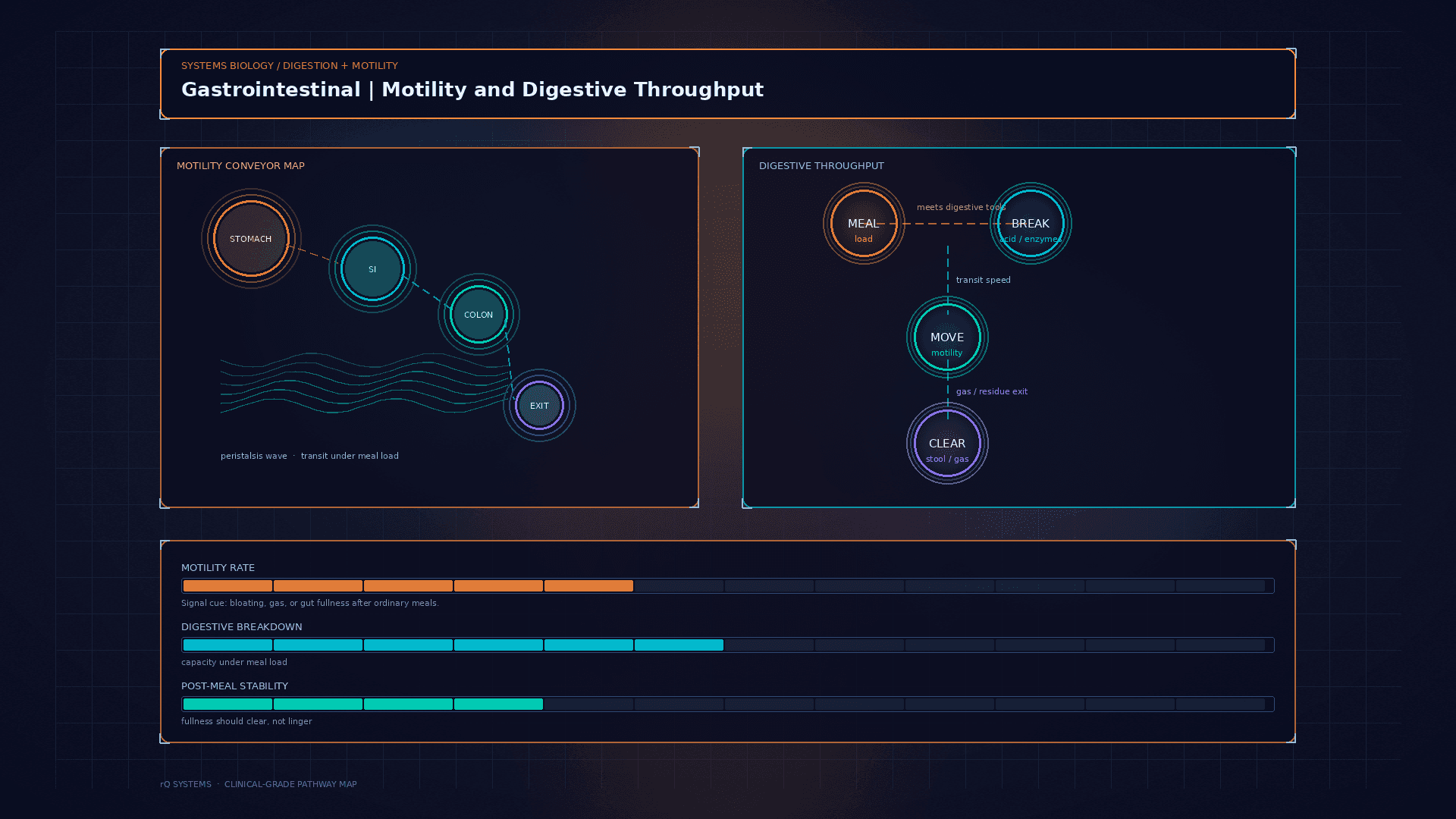
Do you often experience bloating, gas, or gut fullness?
If that pattern is familiar, you already know the afternoon in reverse. You eat. Within an hour or two the midsection feels swollen, gassy, or packed. That is not a character flaw or "just a sensitive stomach." It is a signal about gastrointestinal motility and digestive throughput, how well food moves, breaks down, and clears through the gut without backing up as pressure, gas, or incomplete stools.
Your GI tract is a coordinated tube from mouth to exit. Motility (the wave-like muscle movement that advances contents) and digestive secretions (acid, enzymes, bile) set throughput. When movement slows, fermentation rises, or breakdown is incomplete, bloating, gas, and fullness are common body-level flags. Related pattern language often includes going a full day without a bowel movement, hard dry or incomplete stools, relief after a bowel movement, heartburn or reflux, foul stool odor, undigested food in stool, and histories of dysbiosis, Candida, SIFO, SIBO, leaky gut, or multiple food sensitivities, because those prompts sit on the same motility and digestive-capacity curve.
Why bloating, gas, and fullness cluster after meals
Healthy motility keeps contents moving at a workable pace. Digestion meets the meal with enough acid and enzymes. Gas produced by microbes stays in a tolerable range. When transit stalls, when bacteria ferment carbohydrates higher in the small bowel than they should, or when breakdown leaves residue, pressure builds. You feel bloated or gassy. Fullness can linger long after the plate is empty. Related signals like constipation, diarrhea swings, reflux, and foul or incomplete stools often share that same throughput bottleneck.
That is why "bloating, gas, or gut fullness" is such a precise systems prompt. It maps a defined load (ordinary meals) to a failure of motility and digestive clearance. Capacity under load still applies. Gut function is an operating curve for transit and breakdown across the day, not a willpower problem about "eating clean enough." Map meal composition, meal spacing, fiber and fluid timing, stress at mealtime, stool frequency and form, and recovery against that curve instead of blaming yourself for a weak stomach.
What motility and digestive throughput mean in plain language
Think of the gut as a conveyor and a processing plant. Motility is the conveyor speed. Acid, enzymes, and bile are the processing tools. The microbiome is the on-site workforce that should stay in balance. When the conveyor slows, stools harden, days get skipped, and gas rises. When processing is incomplete, you may see undigested food, foul odor, reflux, or food sensitivities that multiply. When the workforce overgrows in the wrong segment (patterns often labeled SIBO or SIFO in clinical settings), bloating after carbohydrates can dominate.
GI capacity sits beside liver and bile flow, nervous system stress tone at meals, sleep, antibiotic and diet history, and total inflammatory load. A systems map beats a single "I am just gassy" story. Post-meal bloating and fullness are high-leverage windows because they make motility and digestive throughput failure obvious within a single eating cycle.
Reading the bloating signal with precision
A clear yes to frequent bloating, gas, or gut fullness flags a possible mismatch between meal load and GI motility or digestive capacity. Pair that answer with context: stool frequency (including full days without a bowel movement), hard dry or incomplete stools, relief after going, diarrhea episodes, heartburn or indigestion, stool odor, undigested food, prior dysbiosis or SIBO or SIFO labels, food sensitivity lists, and whether smaller meal spacing, slower eating, and steadier fiber and fluid timing soften the bloat over two to four weeks.
Precision turns vague "my stomach is always off" into a measurable motility and throughput problem. Track a few days if you can: post-meal bloat score (1 to 10), gas timing, stool form, days with no bowel movement, reflux notes, and which inputs (chewing thoroughly, earlier dinner, walking after meals, consistent morning toilet routine) reduce the cost.
Practical next steps
Right-size meal load while you rebuild motility. Prefer meal sizes you can finish without a packed-full feeling, chew thoroughly, and avoid stacking large late dinners back to back. Note whether bloating and gas ease as meal timing stays steadier for two to four weeks.
Support the transit basics. Daily walking after meals, consistent morning bathroom time, adequate fluid with fiber from vegetables and whole foods, and calmer mealtime stress often help motility more than jumping between extreme elimination diets. Track one simple daily score (bloat 1 to 10, stool ease 1 to 10) so the curve becomes visible.
Bring the gut map to clinical care. Persistent bloating with constipation or diarrhea, reflux that does not settle, foul stools, undigested food, or a history of SIBO, SIFO, Candida, or expanding food sensitivities deserve a qualified clinician who can evaluate motility, digestive capacity, microbiome drivers, and other drivers of illness that keep throughput congested. Pattern plus operating data is more actionable than either alone.
The rQ Perspective
Gastrointestinal motility and digestive throughput are one node in a whole-body digestion, nervous system, and detox network. The useful signal is how meal load, transit speed, breakdown capacity, gas production, stool output, and stress tone interact. When you map the system, "I bloat after almost every meal" becomes an observation that guides better inputs instead of a fixed gut-shame sentence.
The rQ assessment is the most comprehensive functional medicine assessment on the market. It gives a clinical-grade look at genes, detox pathway functionality, and drivers of illness such as pathogens, and it helps people understand their body. Start at www.rq.one.
Chase answers, not symptoms.
Take the rQ assessment
Back to Journal